Tanzanian learners are faced with educational disparities, stemming from improper and unreliable infrastructure. In 2024, the Tanzania National ICT reported that only 28% of public schools have reliable access to computers, while fewer than 15% have stable internet connectivity. Despite the deficit, according to World Bank, over 70% of teachers have shown interest in integrating digital tools into their lessons, but only 32% have received formal training in platforms such as AI-assisted learning. Access to reliable internet persists as TCRA’s 2025 study highlights that internet penetration nationwide stands at 58%, mainly concentrated in urban areas, leaving rural areas behind. These statistics underline the urgency for continued investment, collaboration, and capacity-building to ensure equitable access to digital education for all Tanzanian learners.
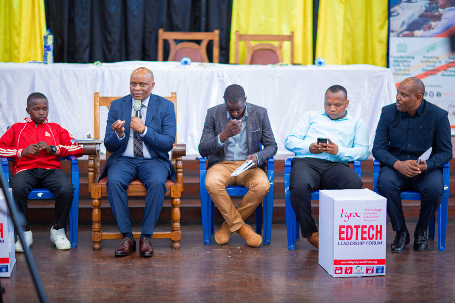
On 29th November 2025, the EdTech Leadership Forum brought together educators, policymakers, innovators, and students in Iringa for a landmark conversation on the future of digital learning in Tanzania. Co-hosted by Lyra Africa Organization in partnership with the Jakaya Mrisho Kikwete Foundation (JMKF), the event served as a powerful call to reimagine how technology, especially Artificial Intelligence, can influence equitable, creative, and effective learning environments across the country.
In an effort to encourage equitable representation during the national digital transformation dialogue, the JMKF was honored to sponsor the participation of teachers from Zanzibar (MoEVT),
The forum kicked off with warm remarks from Lyra Africa’s Konzo Ikweta and the guest of honour, Victor Bwindiki, from MoEST. Both speakers reinforced the urgent need to prepare Tanzanian learners for a digital-first world.
As the day unfolded, the speakers and participants unpacked and discussed the transformative potential of AI tools, such as ChatGPT and Gemini. The tools were perceived to be practical companions that can support lesson planning, accelerate marking, enhance creativity, and reduce administrative burdens for teachers, rather than distant, futuristic technologies.
One of the sponsored teachers, Haji Pandu Haji, gave an outstanding session where he demonstrated how AI can simplify complex concepts and deepen student engagement. He illustrated practical use cases, ranging from rapid generation of reading passages to the application of AI in science revision, sparking excitement across the room.
Lyra Africa’s subsequent sessions broadened the discussion to include wider digital integration: How to incorporate AI into everyday teaching, how learners can use digital tools responsibly, and how schools can turn technology into an accelerator of curiosity rather than a barrier.
The discussions were concluded with a powerful message from Mr. Henry Kulaya, Senior International Advisor, urging the government and partners to prioritize digital access to in schools including computers, tablets, and strong digital literacy programmes. His message strongly aligned with JMKF’s long-standing mission: improving access, equity, and innovation in Tanzania’s education landscape.
Building on the discussions, the forum outlined a series of practical next steps, including:
- The submission of the proposed digital learning curriculum to MoEST,
- Lyra Africa’s commitment to donate 366 computers to schools across Tanzania,
- A deeper collaboration among MoEST, MoEVT, Lyra Africa, and JMKF to ensure that no student is left behind in the digital transition.
“Being here from Zanzibar has opened my mind. We are going back home with a renewed energy to push for digital learning in our schools.” — MoEVT Teacher from Zanzibar
The EdTech Leadership Forum was more than a one-day gathering—it was a statement of intent. A collective acknowledgement that Tanzania is ready to harness the potential of AI and digital learning to shape a brighter, more inclusive future.